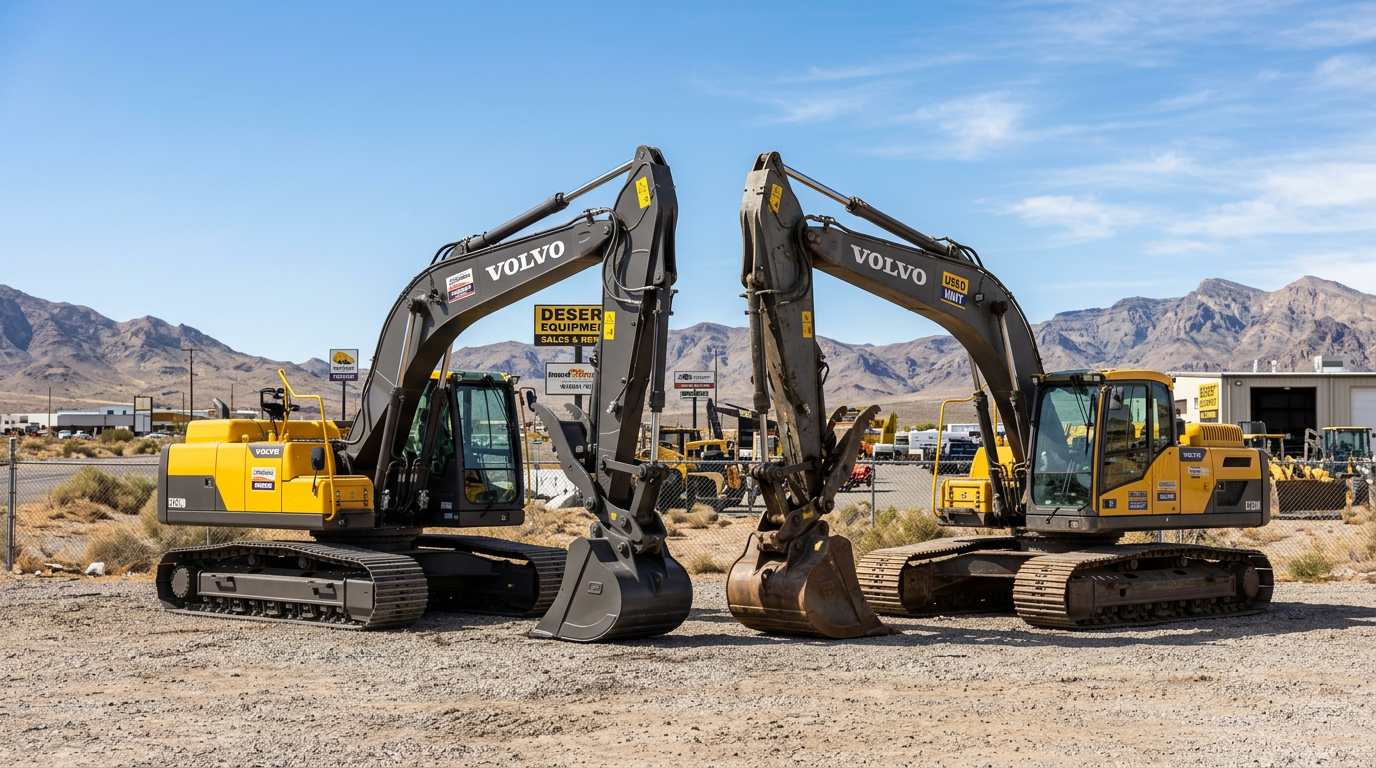
Why Midland-Odessa Is a Different Used Equipment Market
Midland and Odessa sit at the heart of the Permian Basin — the most productive oil-and-gas basin in the world and one of the most demanding environments for heavy construction equipment. Whether you're a pipeline contractor, a pad-site builder, a caliche road grader, or a municipal contractor serving the Midland-Odessa metro, the local used equipment market has its own rules.
WTI crude prices don't just move gas stations here — they move the entire equipment market. When oil climbs above $80/barrel, E&P companies accelerate drilling programs and pad construction, demand for dozers and excavators spikes, and prices follow. When oil dips, equipment sits, operators sell off fleets, and buyers with cash can find genuine bargains. Understanding where the Permian Basin sits in that cycle today is step one of any smart purchase.
What Contractors Are Buying in the Permian Basin
The Permian Basin's equipment mix is skewed by its core industry. While a Phoenix or Houston contractor may need a broad fleet, West Texas operators tend to concentrate on:
- Crawler dozers (D6–D8 class) — caliche road construction and pad grading are the dominant earthmoving tasks; a D6T or equivalent is the workhorse machine
- Motor graders — caliche and shell-base roads require constant blading; graders are ubiquitous on Permian Basin lease roads
- Excavators (15–25 ton class) — pipeline trenching, pit construction, water impoundment berms, and spill containment
- Wheel loaders (3–5 yd³) — caliche stockpile handling and aggregate loading at water-transfer and frac-sand facilities
- Skid steers and compact track loaders — tank battery site work and tight-space utility trenching
- Vacuum trucks and hydrovacs — buried utility potholing before excavation; these are not earthmoving equipment but are often sold alongside them in Permian Basin fleets
If you're buying a dozer or grader specifically for oilfield road work, look at machine hours in context: a D6 with 6,000 hours in Permian Basin caliche work has led a very different life than the same machine with 6,000 hours on a Texas Hill Country residential subdivision. Caliche is abrasive, operators often run machines in demanding conditions around the clock, and routine PM intervals sometimes get stretched during drilling-campaign pushes.
Understanding Permian Basin Geology and Its Effect on Equipment
West Texas caliche is the defining soil challenge in Midland-Odessa. Caliche (calcium carbonate hardpan) ranges from a few inches to several feet thick and can be almost concrete-hard in the summer heat. Working in caliche accelerates wear on:
- Cutting edges and blades — expect above-average wear on dozer blades, grader blades, and bucket lips
- Undercarriages — abrasive silica in West Texas soil increases bushing and link wear rates on tracked machines compared to softer soil markets like East Texas
- Air filtration systems — dusty conditions are extreme, especially in wind events; dirty or collapsed air filter elements cause premature engine wear
- Cooling systems — high ambient temperatures (110°F+ in July) combined with heavy cycle work push cooling systems hard
When inspecting used equipment from Permian Basin fleets, pay extra attention to these systems. A machine that looks clean topside may have worn-out undercarriage components or a cooling system that's been running hot for years.
How to Find Used Heavy Equipment for Sale in Midland-Odessa
The Permian Basin has several channels where used iron surfaces:
Online Marketplaces and Regional Dealers
National platforms like EquipMarket list West Texas equipment alongside regional listings. Searching by location lets you find equipment available for local inspection and pickup — avoiding the freight costs that make buying from distant states expensive for machines under $75,000. Dealers in Midland and Odessa (CAT, Komatsu, and John Deere all have Permian Basin dealer networks) typically stock well-serviced trade-ins from energy-sector fleets, though their pricing reflects dealer reconditioning costs.
Direct Fleet Sales from E&P and OFS Companies
Oilfield services companies (OFS) — pipeline contractors, compression station builders, water management operators — regularly rotate equipment out of aging fleets. These sales often happen with little marketing outside the local network. Building relationships with local fleet managers or watching county auction notices is how many Permian Basin operators find their best deals.
Regional Auctions
Iron Planet, Ritchie Bros., and regional Texas auction houses hold regular Permian Basin equipment sales, often scheduled after large drilling-campaign completions or during oil-price downturns when operators cut capital spending. Auction pricing reflects market conditions in near real-time, making them a useful benchmark even when you're buying privately.
10-Point Pre-Purchase Inspection Checklist for Permian Basin Equipment
Before you buy any used machine out of a West Texas fleet, run through these checks. See our full 10-point inspection checklist for detail on every item.
- Air filter and pre-cleaner — Pull the element. A collapsed or clogged element is a sign of deferred maintenance in dusty conditions.
- Cooling system — Check coolant color and oil content (milky = head gasket leak); inspect fins for plugging with caliche dust.
- Engine oil and fuel filters — Sample and send for analysis; review the machine's oil-sample history if available.
- Undercarriage wear — Measure link, bushing, and sprocket wear (aim for ≥50% remaining). Permian Basin machines often need undercarriage at 3,000–4,000 hours instead of the standard 5,000–6,000.
- Hydraulic system — Check fluid condition and sample; inspect all hoses, fittings, and cylinder seals for UV/heat cracking.
- Blade / bucket / cutting edges — Measure remaining steel. Budget for replacement if worn below 50%.
- Cab and controls — HVAC is non-negotiable in West Texas; confirm A/C pulls temperature down to at least 68°F in ambient heat. Check all joystick and control functions.
- Frame and structural steel — Look for fatigue cracks in dozer push-arms, excavator boom-arm welds, and loader frame joints from high-cycle work.
- Telematics/ECM data — Modern machines store idle hours, fault codes, and DEF/emissions data. Pull the ECM history before closing the deal.
- Title, lien, and UCC check — Energy-sector equipment is often used as collateral. Run a UCC lien search on the serial number before any money changes hands.
Pricing Benchmarks: What Used Equipment Costs in Midland-Odessa
Equipment prices in the Permian Basin tend to track the broader Texas market with an oilfield premium during high-activity periods. These are 2026 representative ranges for machines in Good–Fair condition (source: regional dealer pricing, recent auction results, and EquipMarket listings):
- CAT D6T / Komatsu D65 dozer (2015–2020, 4,000–7,000 hrs): $85,000–$140,000
- CAT 120/140 motor grader (2014–2019, 5,000–9,000 hrs): $70,000–$120,000
- CAT 320 / Komatsu PC210 excavator (2016–2021, 4,000–7,000 hrs): $90,000–$160,000
- CAT 966 / Komatsu WA380 wheel loader (2015–2020, 5,000–9,000 hrs): $95,000–$160,000
- CAT 299D / Bobcat T870 compact track loader (2017–2022, 1,500–3,500 hrs): $40,000–$70,000
During oil-price downturns, price floors for oilfield-spec equipment can drop 20–30% as operators liquidate. If you're buying counter-cyclically, you can stretch your budget significantly — but you'll need financing in place before the window closes. See our lease vs. finance guide for help structuring the deal.
Equipment Financing for Midland-Odessa Contractors
West Texas contractors have access to the same national lenders as anyone else, but a few local realities matter when you apply:
Oilfield Revenue Cycles and Lender Underwriting
If your primary income comes from oilfield services, lenders will look closely at your revenue concentration (what percentage comes from a single E&P operator) and at commodity-price exposure. Some conventional lenders apply tighter loan-to-value ratios for oilfield-sector borrowers; specialty equipment lenders are more comfortable with this profile.
How Do I Apply for Equipment Financing?
The fastest path to financing in Midland-Odessa is through a lender that understands heavy equipment and the energy sector. Equipment financing through South End Capital is available for Texas contractors buying used equipment from private sellers or dealers — including Permian Basin oilfield operators. South End Capital works with owner-operators, small contractors, and established firms, and can finance used equipment in Good or Excellent condition from a private sale or dealer with as little as 10% down in many cases.
To apply: visit the South End Capital link above, describe your equipment (make, model, year, serial number, condition, purchase price), and provide 2–3 years of tax returns or business financials. Pre-approval typically takes 24–48 hours.
Section 179 and Bonus Depreciation for West Texas Buyers
If you're buying before year-end, a financed purchase can be immediately expensed under Section 179 (up to $1,220,000 in 2026) or partially deducted under bonus depreciation. Consult your tax advisor, but for active contractors who are profitable this year, buying and placing equipment in service before December 31 can significantly reduce your tax burden. Our Section 179 guide covers the full mechanics.
Frequently Asked Questions: Buying Heavy Equipment in Midland-Odessa
Is oilfield-used equipment harder to finance than regular construction equipment?
Not necessarily harder, but the underwriting looks different. Lenders will want to understand your customer concentration and how oilfield revenue cycles affect your ability to make payments. Specialty equipment lenders like South End Capital are experienced with this — conventional bank loans can sometimes be trickier to structure for oilfield-dependent contractors.
Where can I get a heavy equipment inspection in Midland-Odessa?
Several third-party inspection services operate in the Permian Basin, including national providers like Machinery Scope and Landstar. Local CAT and Komatsu dealers also offer pre-purchase inspections for a fee. Always use an independent inspector for private-party purchases — never rely solely on the seller's condition report.
How does a boom-bust oil cycle affect used equipment pricing?
When oil prices spike, equipment demand surges and used prices rise — sometimes 20–40% above trough values in 12–18 months. When prices fall, E&P companies cut capex, oilfield services contractors idle equipment, and used prices drop. Buying during a trough — if you have cash or financing lined up — produces the lowest cost-of-acquisition. Buying at a boom peak risks paying above replacement value for aging iron.
What's the best way to transport equipment from Midland-Odessa to my job site?
Midland-Odessa is roughly 3.5 hours from San Angelo, 5 hours from Lubbock, and 4.5 hours from El Paso — and significantly farther from major freight hubs. For machines under 80,000 lbs (most excavators and dozers), a standard low-boy with a CDL driver handles the haul. For over-size loads, Texas Dept. of Transportation permits are required (typically 3–5 business days processing). Budget $3–$6 per loaded mile for transport on top of purchase price when comparing sellers at distance.
Do I need a different warranty or protection plan for oilfield-used equipment?
Extended service plans (ESP) and used-equipment protection plans are available through major OEM dealers for qualifying machines (typically under 7,000 hours and under 10 years old). Given the high wear rates in Permian Basin conditions, an ESP on a freshly purchased machine can be worth the premium — especially for major components like the transmission and hydraulic pump. Ask your dealer about component-specific coverage terms.
Can I buy equipment directly from an E&P company's fleet sale?
Yes, and this can be a source of well-maintained, high-value machines at below-dealer pricing. Large E&P operators (Chevron, Pioneer/Exxon, Coterra, Diamondback Energy) and major OFS firms (Halliburton, Schlumberger, Patterson-UTI) periodically hold fleet disposition sales. These are announced through regional auction houses or directly to known contacts. You'll usually be competing with other experienced buyers, so having financing pre-approved and knowing what you want to pay before the sale is essential.
Final Checklist Before You Buy in Midland-Odessa
- ✅ Run a UCC lien search on the serial number — oilfield equipment is commonly collateralized
- ✅ Commission an independent third-party inspection before any deposit
- ✅ Pull ECM fault code history and oil-sample records if available
- ✅ Verify the machine's hours are consistent with its visual wear patterns
- ✅ Get financing pre-approved before you start negotiating — sellers take pre-approved buyers more seriously
- ✅ Budget for transport (3–6 $/mile loaded) and any immediate maintenance based on inspection findings
- ✅ Confirm Section 179 timing with your CPA if purchasing before year-end
Ready to browse used heavy equipment for sale in West Texas? Search current EquipMarket listings or list your own equipment for free to reach contractors across the Permian Basin and beyond.