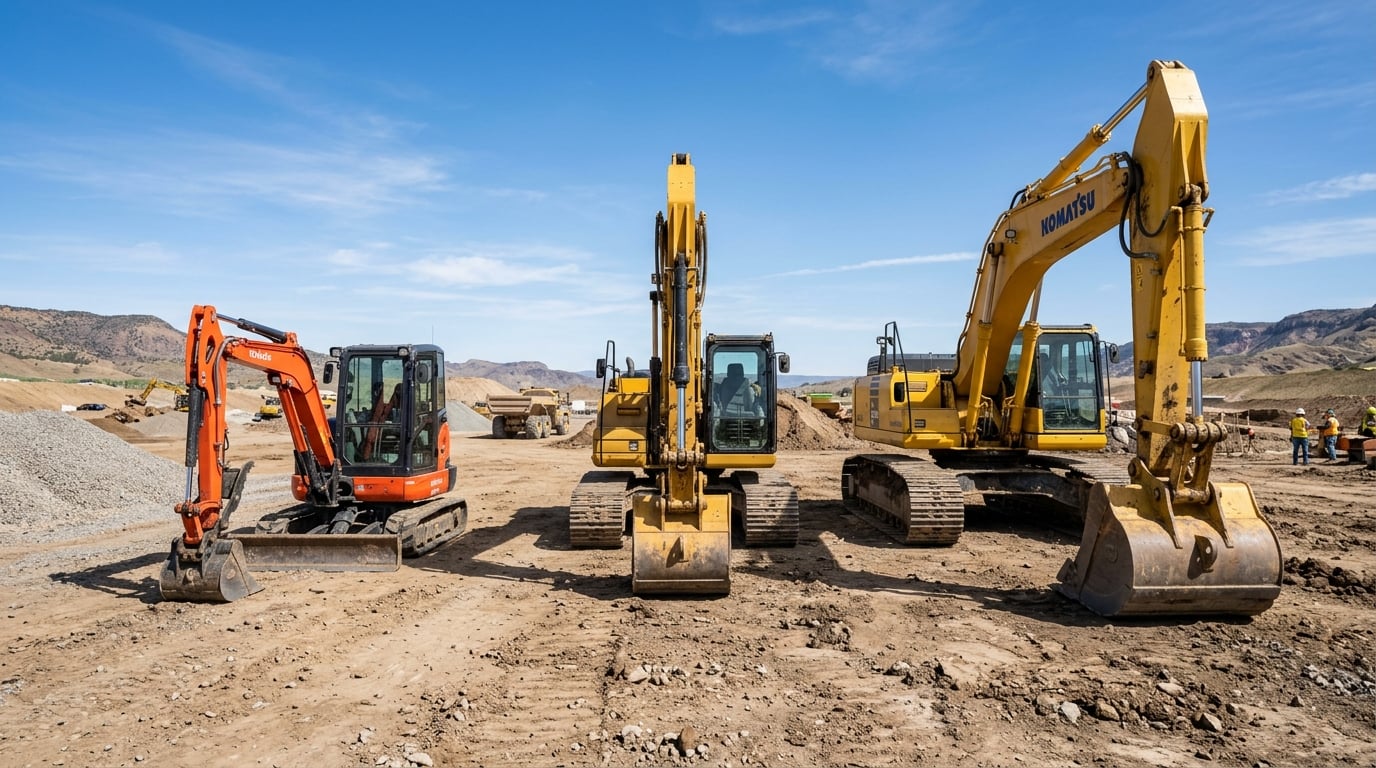
Caterpillar builds more excavator variants than any other manufacturer, and the naming can be genuinely confusing if you didn't grow up around the iron. A 320 and a 320 GC are not the same machine. A 336D and a 336 are separated by two generations of technology. This guide decodes the CAT excavator lineup so you can shop with confidence.
How to read a CAT excavator model number
Once you know the pattern, the model number tells you most of what you need:
- The number is roughly the size class. On the modern lineup, the leading digits scale with operating weight. A 305 is a 5-ton-class mini; a 320 sits in the 20-ton class; a 336 is in the mid-30s; a 349 is pushing 50 tons. It's not a precise conversion, but it's an excellent first sort.
- Decimal models are minis. Anything written as 301.x, 302, 303, 305.5 and so on lives in the compact family, generally under about 10 tons.
- Trailing letters are generations. Older machines carry a letter suffix — B, C, D, E, F — that marks the design generation. A 320D is older than a 320E, which is older than a 320F. Later machines added a second-level suffix like D2 or D3 for mid-cycle updates.
- "Next Generation" machines often dropped the letter. When Caterpillar overhauled the line, several models went back to a bare number — a plain 320, 323, 330 or 336 is the newer Next Gen machine, not an ancient one. This trips up a lot of buyers reading listings.
- GC means "General Construction." A GC model is a deliberately simplified, lower-cost version aimed at lower-duty-cycle work. It typically carries fewer electronics and a lower price, both new and used. It is not a defective or stripped machine — it's a different value proposition, and it can be a smart buy if you don't need maximum production.
- XE indicates a high-efficiency drivetrain on select models, generally aimed at cutting fuel burn.
The CAT excavator classes
Mini excavators (roughly 1–10 tons): the 300.9D through 310
This is Caterpillar's compact family — machines like the 301, 303, 305.5, 307, 308 and 310. They're built for residential work, landscaping, utility trenching, and any site where access is tight or you need to protect finished surfaces. Many are available in zero or reduced tail swing configurations so they can work along a wall or fence line. Transport is simple, often behind a heavy pickup or on a small trailer, which keeps job costs down.
The trade-off is reach and breakout force. Minis dig shallow footings, trenches and utility runs well; they are not mass-excavation machines.
Small and midi excavators (roughly 13–18 tons): 313, 315, 317, 318
The bridge class. You gain real dig depth and lifting capacity over a mini while staying transportable and maneuverable. For a contractor who has outgrown a compact machine but doesn't want the cost and logistics of a 20-ton machine, this range is often the sweet spot for a single do-everything excavator.
Standard excavators (roughly 20–36 tons): 320, 323, 325, 326, 330, 335, 336
This is the heart of the market and the reason the 320 and 336 are among the most recognized model numbers in construction. These machines handle commercial site development, road building, utility mains, mass excavation and truck loading. Attachment support is extensive — hammers, thumbs, couplers, shears, grapples.
There's a practical resale argument here too. Because these sizes are so common, the used market is deep and liquid: they are easier to buy at a fair price and easier to sell when you're done with them. If resale matters to you, this class is the safest place to spend.
Large excavators (roughly 40 tons and up): 340, 345, 349, 352, 374, 395
Purpose-built production machines for quarry, mining, and large-scale earthmoving. Enormous bucket capacity and dig force, but they bring real logistics: multi-piece transport, higher fuel and wear costs, and experienced operators. Buy in this range only when the volume of work genuinely justifies it.
Which CAT excavator should you buy?
Three questions settle it most of the time:
- Size for your routine heavy day, not your rare extreme. Rent up for the occasional oversized job rather than owning too much machine year-round.
- Check your access and transport limits first. Gate widths, ground protection, trailer capacity and haul cost can eliminate an entire class before you compare specs.
- Decide whether you need Next Gen electronics. Grade control, payload weighing and advanced monitoring genuinely speed some work — and add complexity and cost on others. A well-maintained older D or E-series machine can be a far better value if you don't need the tech.
Before you buy any used CAT
Model knowledge gets you to the right shortlist; inspection gets you to the right machine. Run every candidate through our 10-point used equipment inspection checklist, weigh the hour meter using our guide to operating hours and resale value, and confirm the machine's identity and build year with our Caterpillar serial number guide.
For a quick baseline on what a specific machine should cost, run it through the free Equipment Value Estimator. When you're ready to shop, browse used excavators for sale on EquipMarket — buyer financing is available for qualified purchasers.