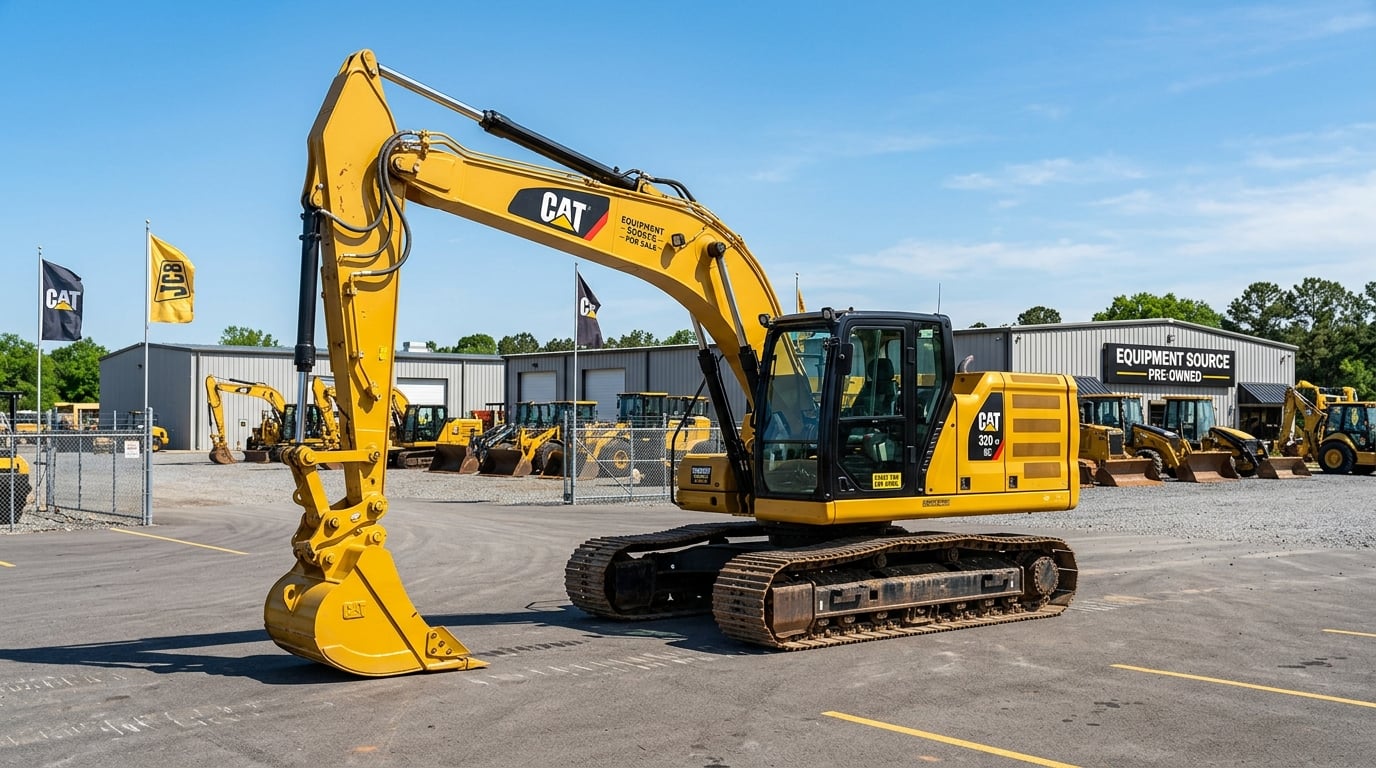
Ask around any equipment yard and you'll hear the same thing: Caterpillar holds its value. It's one of the most repeated claims in the industry, and broadly it's true — but "holds its value" is not a number you can put in a contract. If you're buying, you want to know whether the CAT premium is worth paying. If you're selling, you want to know how much of it you can actually capture. Here's the honest breakdown.
Why used CAT equipment commands a premium
The premium isn't brand loyalty for its own sake. It rests on four practical things buyers are paying for:
1. Parts availability and dealer density
This is the biggest one, and it's underrated by first-time buyers. A machine that's down costs you money every hour it sits. Caterpillar's dealer network is among the deepest in North America, which means parts and service are typically easier to source than for less common brands. Buyers pay real money for reduced downtime risk.
2. Documentation and service history
Because CAT machines are usually dealer-serviced, they more often come with a traceable maintenance record. Documented history is worth actual dollars — it converts an unknown machine into a known one.
3. Buyer demand and market liquidity
Common CAT models attract more bidders. More bidders means a faster sale at a firmer price. A 320-class excavator or a mid-size CAT dozer will typically find a buyer faster than an equivalent machine from a brand with a thinner following.
4. Rebuildability and component life
Major components on popular CAT models have well-understood service lives and a mature market for rebuilt parts. That means a high-hour machine still has a defined path forward instead of being a write-off.
What the premium is NOT
Here's where sellers overreach. A CAT badge does not:
- Offset missing records. An undocumented CAT is still an undocumented machine, and buyers discount it accordingly.
- Erase high hours. Hours and proximity to major service events drive price hard regardless of brand — see our operating hours guide.
- Cover structural damage. Cracked booms, heavy weld repairs, and a worn-out undercarriage cost the same to fix on any brand.
- Apply evenly across the lineup. Popular mid-size models carry the strongest premium. Niche configurations, oddball sizes, and stripped-down variants track much closer to the broader market.
Which CAT machines hold value best
Value retention tends to concentrate where demand is deepest:
- Mid-size excavators (roughly the 320 through 336 range). The deepest, most liquid used market in the entire category. Broad contractor demand, wide attachment support, easy to resell.
- Mid-size dozers (the D5 and D6 classes). Constant demand from site development, land clearing, and road work.
- Compact track loaders and skid steers. Very high turnover and a broad buyer base that includes landscapers, small contractors, and owner-operators. See our CAT skid steer comparison.
- Mid-size wheel loaders. Steady demand from aggregate, agriculture, and yard operations.
Conversely, very large mining-class machines and highly specialized configurations have a much smaller buyer pool, which makes pricing less predictable and sale times longer.
How to price a used CAT accurately
Whether you're buying or selling, work the same five steps:
- Pin down the exact machine. Model, generation suffix, and build year. A 336D and a Next Gen 336 are different machines at different price points — confirm which you have using the serial number.
- Pull real comparables. Same model, similar year, similar hours. Sold prices beat asking prices; asking prices set the ceiling.
- Adjust for hours against the ~1,000–1,200 hours/year benchmark. Well under it is a premium; well over it is a discount.
- Adjust for condition and documentation — honestly. Complete records and a clean undercarriage sit at the top of the range. No records sits near the bottom, CAT badge or not.
- Price the attachments separately. Couplers, thumbs, extra buckets and auxiliary hydraulics carry independent value.
You should end up with a defensible range, not a single number. Buyers negotiate against ranges too, so knowing yours — including your walk-away figure — is the whole game.
Get your number
Our free Equipment Value Estimator runs this logic in seconds: enter make, model, year, hours and condition and get an instant estimated resale range you can use as a baseline before you negotiate.
Selling? Listing your CAT equipment on EquipMarket is free. You set the price, we handle the marketing and put the machine in front of active buyers, and buyer financing helps qualified purchasers close faster. You only pay when it sells. Buying instead? Browse current listings here.